Posts

Showing posts with the label MIDISID Monday

#MIDISID Monday 11 July - monophonic mode, honky tonks and an annoying hum

Image
This first video is about monophonic mode. I'll be talking about the modes a lot because MIDISID works in three very different ways and it'll be good to demo them as much as possible.  In this one I talk about the honky tonk and how we might reproduce that rustic sound. I've also been working on an annoying hum I've been experiencing since building the last revisions of the boards. Counterintuitively it seemed worse when on battery power (there's a clue). Today I've been cutting traces and adding bodge wires. Adding capacitors and generally messing around, trying to find out where the problem lies.  Here is the problem. The first half of this demonstrates the problem. You'll hear the chime of the SwinSID Nanos as I apply the power, and then you'll hear the hum before the music starts.  The second half is how things sounded after fixing the problem. The hum is undetectable and the sound level is better (these things are visually obvious too in the Sound S...

MIDISID Monday, General MIDI mode with a wacky solo

Image
This week has mostly been spent working on mono mode but it's not yet ready for a demo. Components have arrived for the next hardware version (which is going to look great) but the boards haven't turned up yet. So the update this week will consist of a piece of music I put together partly to demo MIDISID's General MIDI mode, and partly to have fun playing with a new instrument I've just put together. Rakits are a fab introduction to the world of modular synthesis, I love my baby8 and atari punk console. I had the good fortune to meet the 'MakeaRakit team' at emfcamp a couple of weeks ago and couldn't resist buying some more kits. What attracted me to the Cracklebox was partly the method of playing it and partly the unpredictability, which goes against my nature completely.  You have a little control but really don't know what you're going to get. Something quirky and slightly sinister was required for a backing groove. A 3+3+2 (which has a waltz fee...

MIDISID Monday 20 Jun : playing with sound

Image
In one respect it doesn't seem as if we're very much further on than last week because what I have to demonstrate are the parameters within polyphonic mode. If you liked the animated visualisation of the ADSR envelope last week, then this is more of the same, but this time a proper run-through of all of the parameters that make the SID the legendary synthesiser on a chip that it is. We now also have animated representations of the Pulse Width, Pulse Width Modulation, Filtering, Vibrato. Tuning is also incorporated with fine and coarse controls.  In other respects we've made leaps forward and the finished product seems closer. I've done a lot of work on the boards. As the output circuit really needs 9v, I've added a 9v jack / battery clip and regulator and put all the ports neatly at the back.  Incidentally, with the audio circuitry powered from a good 9v source and the chips powered by regulated 5v from that. the audio output is way better than when driving the whol...

MIDISID Monday 13 Jun

Image
This week I've continued to work on the menu / controls and have added something that I'm really pleased with. I've made a video demonstration, with commentary - below the video is a transcript with pictures in case, like me, you prefer text and images. (If you need background, the SID is the sound chip from the Commodore 64, it's a 3-oscillator synthesizer with many features; wave, envelope, pulse width, filters, ring modulation. I'm driving it here with a microcontroller and writing the software to turn this into a midi sound module / musical instrument.) I'd like to demonstrate a feature that I've just added, which I'm really pleased with. Today I've got a MIDI keyboard beside me, plugged into MIDISID using the DIN socket. Its output is audio and I've got that plugged into a portable speaker. I'll be using the polyphonic mode, which puts the same sound on all of the SID voices available and allows you to play up to (in this case with 2 sid...

#MIDISID Monday - the sound of goblins and first look at the form factor

Image
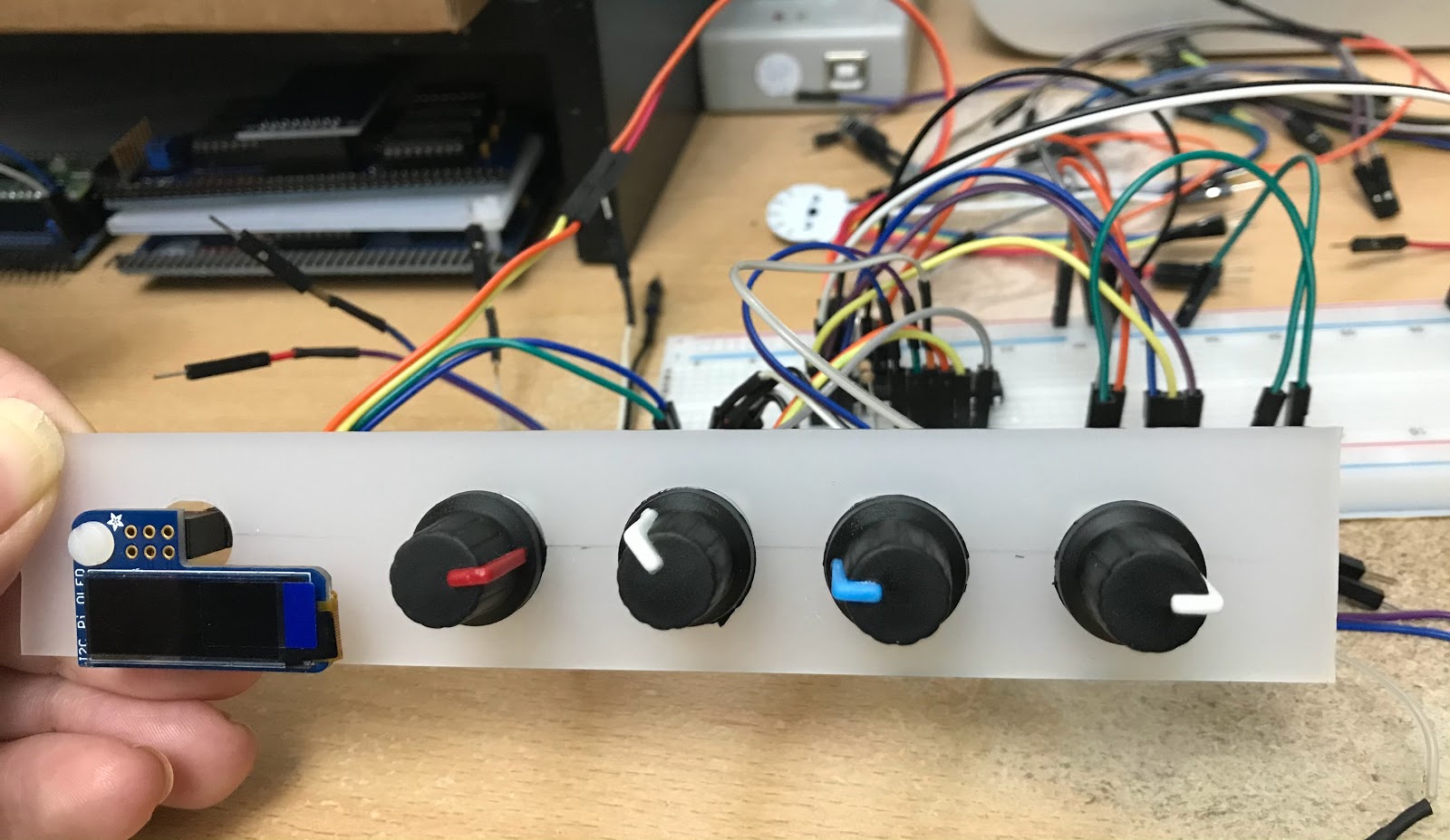
I've started to realise that the quality of the sounds that I build into MIDISID will have a large effect on its appeal. It will be fun to implement some of these: What should 'Goblin' sound like?? These aren't my names, they're part of the General MIDI specification , anything that implements GM should implement all 127 of these sounds in some way.  I've been away for most of this week  but while away,  the board I designed last week has arrived! As with the main board, this is a very quick and dirty iteration, just to get components off the breadboard and securely soldered together while I work on the firmware. This little demo of the menu system is the same as the one I made last week, but here we can see the 2-board system I now have planned. There will be a third layer which is a face plate just below the knobs with a cut-out for the screen. Those three boards could be sandwiched for a nice-looking unit, or separated to fit into any box you like. Alternati...

#MIDISID Monday #2 - A physical UI and menu system take shape

Image
This week has been mostly about the user interface; physical knobs, buttons and screen. I've procrastinated with this because, frankly, I've found designing a menu system hard.  3 modes So the starting point is that MIDISID will have three modes. I've demonstrated two of these many times already. One is general MIDI input, another is MIDI controller input (eg keyboard) with polyphony (hit as many notes at a time as you like, up to a maximum of the number of SID voices). The third is monophonic, which is the same as polyphonic, but making more of the SID's features and using more of the SID voices together to make complex sounds, at the expense of the polyphony. I'd like MIDISID to just work when powered up and given input. So the Mode menu will be the first menu at power-on and General MIDI will be selected and operational. Here's my plan for the menu system. There will be a lot more, but it'll still start with the 3 modes. Mode > General MIDI > D...

MIDISID Monday: When the Pico's 30 GPIO aren't enough

Image
This is the first of a weekly roundup of progress and problems with this project.  (An introduction is here if you need it.)  Two decent steps forward this week are arpeggios and GPIOs .  More GPIOs!  Being short on Pico GPIO pins felt wrong but I have been struggling.  First of all, of the theoretical ~30 on the RP2040, 'only' 26 are easily available to the user.  This project already uses quite a few for SID addressing and data.  We want to be able to add more SIDs in future and each SID requires a chip select.  There just aren't enough available for the push-switch rotary encoders that I'd like for this project. Playing with so many settings using a single knob with push switch is fiddly and would spoil what could be a useful and usable module.  Ideally, I'd love four knobs - to play with A/D/S/R at the same time, or filter/PWM  etc.    Picos are cheap, and the idea of using another to manage the inputs and the display did...